
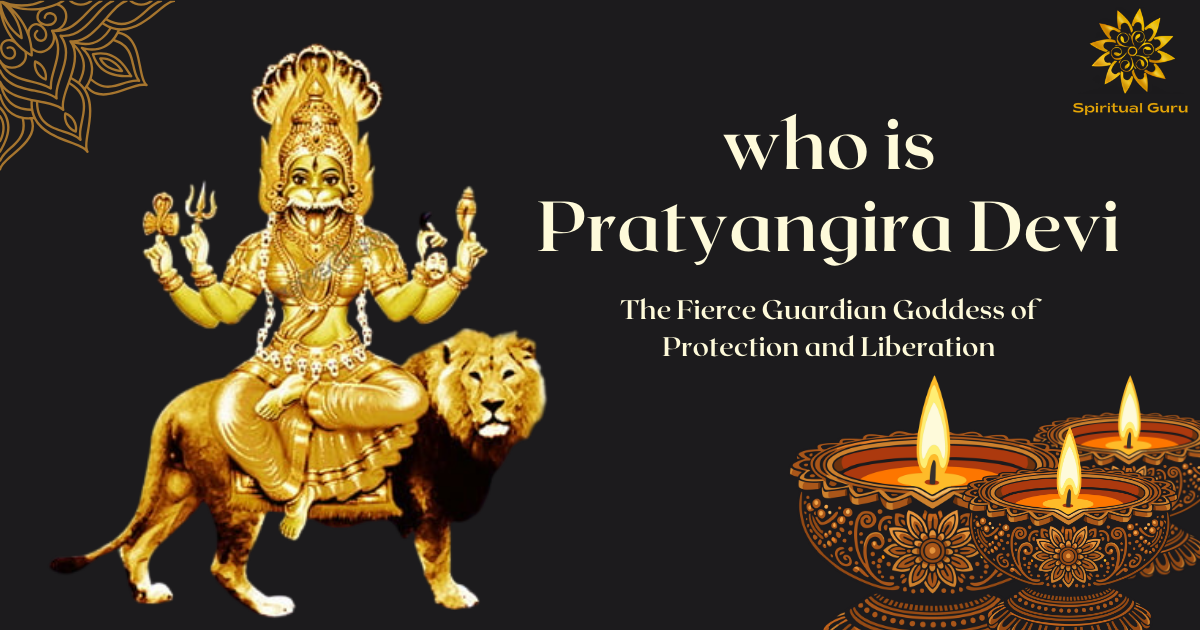
she’s a powerful force of protection, a counter to dark energies, and a path to ultimate liberation. If you’re here because you’re fascinated by Devi forms and eager to explore Pratyangira sadhana. We’ll dive deep into who Pratyangira is, her mythology, practices, and why she resonates so strongly with seekers today.
In this post, I’ll share insights grounded in ancient scriptures like the Atharva Veda and Puranas, along with real-life stories that bring her alive. Whether you’re battling unseen obstacles or simply seeking spiritual depth, understanding Pratyangira can transform your journey. Let’s embark on this exploration together, blending historical facts, expert wisdom, and practical advice.
The Origins of Pratyangira
Pratyangira Devi emerges from the rich tapestry of Hindu mythology as a fierce manifestation of divine feminine energy, or Shakti. Her name, “Pratyangira,” translates to “the one who counters” or “the reverse angira,” hinting at her role in reversing negative forces. According to the Wikipedia entry on Pratyangira, she is associated with Shaktism and is often called Atharvana Bhadrakali, Narasimhi, or Nikumbhala. This multifaceted identity reflects her deep roots in Vedic traditions.
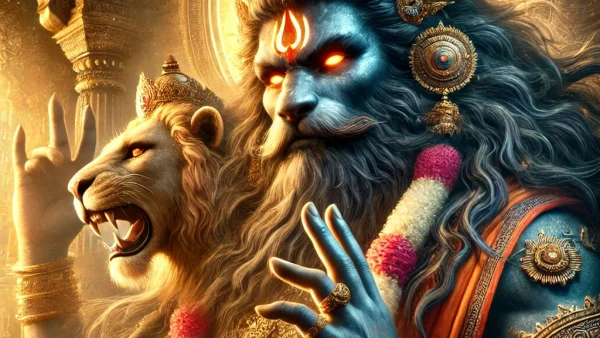
In the aftermath of Lord Vishnu’s Narasimha avatar slaying the demon king Hiranyakashipu, Narasimha’s rage threatened to consume the universe. To quell this uncontrollable fury, Lord Shiva assumed the form of Sharabha, a mythical bird-lion hybrid. From Sharabha’s wing sprang Pratyangira Devi, with the head of a lioness and the body of a woman, embodying raw power and compassion. This tale, drawn from texts like the Tripura Rahasya, illustrates how Pratyangira acts as a balancing force like a storm that clears the sky after chaos.
Experts like those referencing the Devi Mahatmyam describe her as one of the Saptamatrikas, the seven mother goddesses. Pratyangira is worshipped primarily by Kshatriyas for her warrior-like vigor. Historian and mythologist Devdutt Pattanaik, in his discussions on Shakti forms, notes that deities like Pratyangira represent the “wrathful yet protective” aspect of the Divine Mother, much like a mother bear defending her cubs.
But her origins aren’t limited to this legend. In the Atharva Veda, Pratyangira is linked to magical spells and protection rituals, making her the guardian of esoteric knowledge. A cross-cultural study in the Heritage Journal of Multidisciplinary Studies in Archaeology highlights how Pratyangira’s iconography evolved, incorporating elements from sorcery and counter-sorcery practices. This Vedic connection sets her apart, positioning Pratyangira sadhana as a tool for both spiritual and practical defense.
Forms and Iconography
When you visualize Pratyangira Devi, think of a majestic figure that commands respect and awe. Her most common depiction is a lion-faced goddess with a human body, adorned with serpents and wielding weapons like a trident and sword. This form symbolizes her dominion over fearsome energies lions represent courage, while serpents signify kundalini awakening.
In temples like the Ayyavadi Pratyangira Devi Temple in Tamil Nadu, her idol is often shown in a seated posture, exuding calm ferocity. According to India Divine, she appears in various shades: Shantha Pratyangira (peaceful) prefers deep red offerings, while Ugra Pratyangira (fierce) favors purple. On her body, eight snakes coil, offering relief to those with Sarpa Dosham nightmares involving serpents fade under her gaze.
Real-life devotees describe her as “the Mother of the Void,” as per the Pratyangira.org site, emerging from a formless state. Swami Shanmuga, a modern spiritual teacher, shares in his teachings: “Pratyangira Devi comes from a deep place within the Divine Mother, an area referred to as the Void.” This void isn’t emptiness but infinite potential, like the space before a big bang that births creation.
Comparatively, she’s akin to Kali in her destructive benevolence destroying ego and illusions to pave the way for rebirth. Yet, Pratyangira’s focus on countering black magic makes her unique.
Pratyangira Sadhana
If you’re intrigued by Devi sadhana, Pratyangira sadhana offers a profound path, but it’s not for the faint-hearted. This practice aligns your energies with her fierce vibration, leading to protection and moksha (liberation). As outlined in Mahavidya Sadhana Centre, Pratyangira plays a key role in Srividya Sadhana, worshipping the Divine Mother through intricate forms.
Start simple: Begin with her beeja mantra, “Ksham,” which represents her essence. Chant it during meditation, visualizing her form. Pratyangira.org emphasizes Ksham Meditation as an accessible method, distilled by Amma Adi Sakthi: “It allows one to access Pratyangira Devi consciousness with ease.” Practice on auspicious days like Amavasya (new moon) or Ashtami, offering red flowers, lemons, and spicy foods symbols of her fiery nature.
For deeper rituals, homas (fire ceremonies) are common. In the Ayyavadi temple, linked to the Pandavas’ worship, devotees perform these to ward off enemies. A Quora user shares a method: “Pratyangira homa involves chanting her mantra 108 times while offering chilies into the fire, burning away negativities.”
Expert advice is crucial. Pratyangira sadhana warns of shifting to “tamo guna” (inertia) if not balanced: “It can lead to a tamasic lifestyle, though emotions remain unaffected.” advises guidance from a master to avoid risks.
Personal anecdote: During my retreat, I tried a basic Pratyangira meditation. At first, it felt overwhelming like facing my inner demons. But soon, a sense of peace washed over me, dissolving long-held anxieties. It’s like cleaning a dusty mirror; the reflection becomes clearer.
Benefits of Invoking Pratyangira
Worshipping Pratyangira Devi yields tangible benefits, supported by countless devotee testimonies. AstroPuja.com lists key advantages: She neutralizes black magic, evil eye, and tantric attacks. In a world rife with jealousy and hidden enmities, her protection is like an unbreakable shield.
Relief from chronic illnesses is another boon. Those with unexplained ailments find solace, as her energy clears psychic blockages.
On a spiritual level, she grants moksha by dissolving karmas. As the “Mother of Liberation,” per Pratyangira.org, she frees devotees from cycles of rebirth. Studies in Tantric texts, like those in the Heritage Journal, show how her rituals evolved to address material and spiritual needs, blending sorcery with enlightenment.
Is Pratyangira Too Fierce?
Not everyone embraces Pratyangira’s intensity. Critics argue her fierce form promotes aggression or desensitizes to violence, as noted in the Heritage Journal’s analysis of her iconography. In a YouTube discussion, one sadhak mentioned slipping into tamo guna, questioning if her vibration amplifies inertia.
Yet, this overlooks her balancing role. Like fire that destroys but also warms, Pratyangira counters negatives without perpetuating them. Experts counter: Under proper guidance, her sadhana fosters sattva (purity). The journal acknowledges nuances her evolution from sorcery deity to benevolent protector shows adaptability.
Hypothetically, without a guru, risks arise, but that’s true for any tantric practice. Weighing views, her worship suits those ready for transformation, not casual seekers. Future projections? In stressful times, Pratyangira sadhana could rise, offering mental resilience amid global uncertainties.
Pratyangira today
Historically, Pratyangira guarded Vedic secrets, evolving through Puranic tales. Today, temples like Ayyavadi buzz with devotees seeking digital-age protections against cyber threats or emotional drain.
Looking ahead, as wellness trends embrace energy work, Pratyangira could bridge ancient wisdom with modern therapy. Cross-referencing with yoga, her sadhana might enhance mindfulness practices.
In essence, Pratyangira Devi invites us to face shadows for true light. As Pattanaik might say, she’s the “fierce compassion” we need.
Remember, her energy resonates with those seeking protection and growth. As one expert quote sums: “Pratyangira is the pure manifestation of Tripura Sundari’s wrath” (Tripura Rahasya). Let her guide you toward liberation.
What are your thoughts on Pratyangira? Share in the comments let’s keep the conversation alive.
Leave a comment