
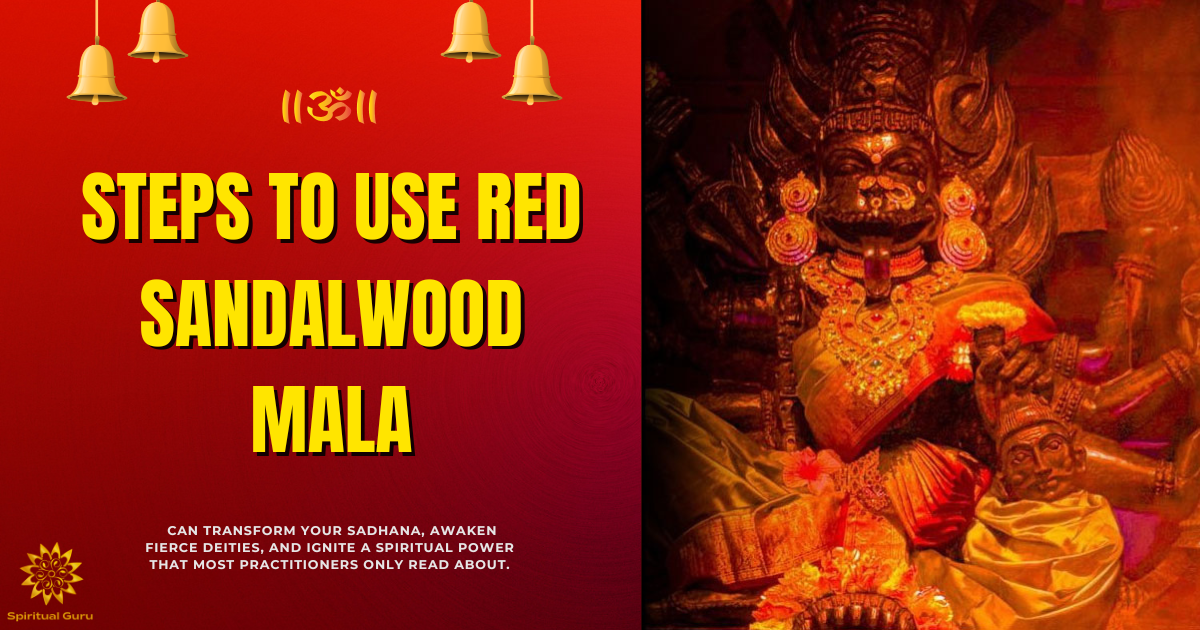
A Guide for Serious Seekers of Ugra Sadhana
There is a moment every sincere seeker encounters a point where gentle prayers and soft mantras feel insufficient. Where the soul craves not the calm waters of devotion, but the raging fire of transformation. If you have arrived at that crossroads, you likely already know what it means to walk the path of Ugra Sadhana.
And if you do, then you need to know about the red sandalwood mala.
This is not a decorative ornament. This is not a bead to be worn casually for its colour. The red sandalwood mala crafted from the wood of Pterocarpus santalinus, the sacred red sandal tree native to the hills of Andhra Pradesh and Sri Lanka is one of the most potent ritual tools in the Hindu tantric tradition. For centuries, yogis, tantrikas, and Devi upasaks have used it to channel the fierce, untamed energies of the most powerful deities in the cosmos.
This guide is written for those who are ready to understand it deeply its properties, its powers, the deities it awakens, and how to use it correctly in your sadhana.
What Is Red Sandalwood, and Why Is It Sacred?
Before we talk about the mala, we must understand the wood itself. Red sandalwood known in Sanskrit as Rakta Chandana (रक्त चन्दन) is not a perfumed wood like white sandalwood. It carries almost no fragrance. What it carries instead is something far older and more elemental: Tejas, the cosmic fire principle.
In Ayurveda, red sandalwood is classified as a tree of intense Pitta energy governed by fire and water. Ancient texts describe its quality as ushna virya (hot potency). This fiery nature makes it wholly unlike any other mala material. Where rudraksha beads invoke Shiva’s ascetic consciousness and tulsi beads invoke Vishnu’s sattvic grace, red sandalwood awakens the rajasic and tamasic energies of the Ugra Devathas the fierce, wrathful manifestations of the divine.
“Rakta Chandana is the wood of Shakti herself in her most formidable form. She does not soften it. She does not cool it. She burns through it, and the mala becomes a conduit for her fire.”
Across the Agamas, Tantras, and Nigamas, red sandalwood is repeatedly prescribed for the worship of fierce forms. The Todala Tantra and several Shakta Upanishads specifically mention Rakta Chandana malas in the context of Kali, Bagalamukhi, and Varahi puja. This is not coincidence it is precise spiritual technology.
The Energy Signature of Red Sandalwood
Think of a mala as an antenna. Different materials tune to different frequencies. Rudraksha beads resonate with Shiva’s consciousness. Crystal malas amplify clarity and Saraswati’s vibrations. Sphatika (quartz) beads are cooling and sattvic. But red sandalwood? Red sandalwood resonates with the frequency of the Ugra Shakti the terrifying, all-consuming, transformative power that destroys what must die so that what must live can flourish.
When you hold a red sandalwood mala, you are not holding wood. You are holding compressed centuries of forest fire, the blood-red earth of Seshachalam hills, and the invoked presence of every tantrika who has ever used this material in their sadhana.
The Ugra Devathas Who Responds to the Red Sandalwood Mala?
The word Ugra (उग्र) means fierce, terrible, and powerful beyond ordinary comprehension. Ugra Devathas are the forms of the divine that most devotees hesitate before. They are not soft. They are not comforting. They are real in the way that a volcano is real unstoppable, transformative, and profoundly dangerous to approach without preparation.
The red sandalwood mala is the tool of choice for propitiating exactly these forms.
Mahakali
The Great Destroyer
The supreme form of the Dasa Mahavidyas, Mahakali is invoked for liberation from fear, enemies, and ego. The red sandalwood mala channels her blood-dark energy powerfully during Kali sadhana.
Bagalamukhi
The Paralyser
One of the ten Mahavidyas, Bagalamukhi is the goddess who stops all opposition. Her energy is specifically aligned with the fiery nature of red sandalwood, making it the preferred mala for her Stambhana sadhana.
Varahi Devi
The Boar-Headed Commander
Varahi, commander of Devi’s armies, is one of the most fierce and powerful Ugra Shaktis. She responds strongly to red sandalwood offerings and is invoked for protection, victory, and the removal of enemies.
Chhinnamasta
The Self-Beheaded One
Among the most intense of the Mahavidyas, Chhinnamasta represents the dissolution of ego at its most radical. Red sandalwood mala sadhana for her is performed by advanced practitioners for deep self-transformation.
Narasimha
The Man-Lion
The Ugra avatar of Vishnu, Narasimha is the embodiment of divine wrath deployed in protection. Red sandalwood mala is used in his Ugra Narasimha kavacham recitation for invincible protection.
Pratyangira Devi
The Lion-Faced Goddess
Pratyangira is among the most powerful protective deities in the South Indian tantric tradition. She is fierce beyond measure, and red sandalwood is described as her preferred material in her ritual prescriptions.
Dhumavati
The Widow Goddess
The seventh Mahavidya, Dhumavati represents the power of void and despair transformed into liberation. Her sadhana, performed during certain auspicious periods, uses red sandalwood to cut through material illusion.
Bhairavi
The Terrifying Goddess
Bhairavi is the fierce consort of Bhairava, embodying the power of dissolution. Her sadhana with red sandalwood mala is particularly prescribed in tantric texts for overcoming internal and external obstacles.
Each of these deities has their specific mantras, rituals, and requirements. What unites them all is their alignment with the fiery, intense energy that red sandalwood embodies. This is why seasoned practitioners keep a dedicated red sandalwood mala exclusively for Ugra upasana it absorbs and amplifies these vibrations over time.
Ugra Sadhana Practices with the Red Sandalwood Mala
Understanding the deity is only the beginning. The real question is: how do you actually practice? Here is a clear outline of the Ugra Sadhanas for which the red sandalwood mala is specifically recommended and traditionally used.
Ugra Sadhanas and Their Applications
- Kali Sadhana (Rakta Kali Japa):Recitation of Kali’s 108 names or the Kali Gayatri using a red sandalwood mala, performed during Amavasya (new moon) nights, particularly effective for liberation from fear and ego annihilation.
- Bagalamukhi Stambhana Prayoga:The practice of “paralysing” negative forces, enemies, or harmful energies using Bagalamukhi’s mantras counted on a red sandalwood mala. Traditionally performed facing south, at midnight.
- Varahi Raksha Kavacham:A protective sadhana invoking Varahi’s fierce armour of protection. The mala is used to count the Varahi Mula Mantra “Om Aim Hrim Klim Gloum Aim Varahi Tharpaya Swaha” for 108 or 1008 repetitions.
- Pratyangira Homam Purvanga:As part of the preliminary practices (purvanga) of the Pratyangira fire ritual, the mala is used to count her seed mantras to establish contact with her consciousness before the main ritual.
- Narasimha Ugra Japa:The Ugra Narasimha mantra particularly his 16-syllable mantra is counted on the red sandalwood mala for protection from black magic, evil eye (drishti), and hostile energies.
- Chhinnamasta Shatru Nivarana:An advanced sadhana for the removal of deep-seated negative forces, performed in cremation ground spirit (shmashana bhavana) even if physically done at home with red sandalwood mala and specific offerings.
- Dhumavati Vairagya Sadhana:The practice of cultivating supreme detachment (vairagya) by meditating on Dhumavati’s form while counting her mantras on a red sandalwood mala. Especially potent on Saturdays.
- Bhairavi Nitya Japa:Daily recitation of Bhairavi’s mantras counted on red sandalwood, performed at dawn, to build the internal fire (tapas) necessary for advanced tantric practice.
The Science Behind These Practices
For those who wonder whether this is “merely superstition,” consider this: the classical texts are not vague about why red sandalwood is used. They are precise. The wood’s vibration its inherent tamasic quality acts as a bridge between the practitioner’s ordinary consciousness and the fierce frequencies of the Ugra Devathas. It is the same principle as using specific musical notes (ragas) for specific times of day. The material creates a resonance.
Modern researchers studying cymatics and vibrational medicine have noted that materials of different densities and molecular structures absorb and emit frequencies differently. While the scientific vocabulary differs from the tantric vocabulary, the underlying observation that matter influences consciousness is consistent across both frameworks.
How to Use Your Red Sandalwood Mala: A Step-by-Step Guide
Possessing a red sandalwood mala is not enough. The way you use it matters immensely. Here is the traditional method, drawn from the living practice of Devi upasaks and Ugra Sadhana practitioners.
- Purify and Consecrate the Mala Before first use, place the mala on a clean red cloth in front of your deity’s image or yantra. Offer red flowers (hibiscus if available), incense, and light a lamp with sesame oil or ghee. Recite the Mala Mantra: “Om Maladhishthaatri Devataabhyo Namah” 108 times while touching the mala. This activates its receptivity to your deity’s energy.
- Establish Your Sitting Practice (Asana) Always sit on a red cloth or a tiger/deer skin for Ugra sadhana. Face the direction prescribed for your specific deity south for Kali and Dhumavati, east for Narasimha and Bhairavi, northeast for Bagalamukhi. Sit in Siddhasana or Padmasana and centre your mind with three deep breaths.
- Hold the Mala CorrectlyThe red sandalwood mala must be held in the right hand for most Ugra sadhanas. Rest it on the right knee or the right hand held at heart level. The mala is draped over the middle finger, moved with the thumb. The index finger (which represents ego) must never touch the mala during japa. The Meru bead (the main bead) must not be crossed when you reach it, reverse direction.
- Begin Japa with Full AttentionWith each bead, recite your chosen mantra mentally (manasa japa) or in a low whisper (upamsu japa) avoid loud recitation for Ugra mantras. One bead equals one repetition. Keep your attention anchored to the mantra sound, not the count. Trust the mala to count for you.
- Complete the Session and Offer the MalaAt the end of each session, bring the mala to your forehead (touching the Ajna chakra), then to your heart, then place it before your deity. Say: “Sampurna Japa Phalamstu” “May this japa bear complete fruit.” Never wear the Ugra sadhana mala casually in public. Keep it wrapped in red cloth when not in use.
Important: Ugra Sadhanas are powerful and should ideally be undertaken under the guidance of a qualified guru or at minimum with serious study of the tradition. Mantras for Ugra Devathas carry intense energy. Begin with shorter counts (21 malas or 11 malas) before building to longer practices. If you feel unusually agitated, stop and perform Devi Stotra recitation to balance the energies.
Caring for Your Red Sandalwood Mala
A red sandalwood mala used in sadhana becomes, over time, a living spiritual instrument. It absorbs the energy of your practice the devotion, the intensity, the accumulated vibration of thousands of mantras. This is why its care is as important as its use.
Never leave it on the floor. Never let anyone else casually handle it. Do not wear it in the bathroom or during sleep unless your sadhana specifically prescribes so. At regular intervals on Amavasya or on your deity’s auspicious days anoint the mala lightly with diluted sesame oil and leave it in the sun for a few hours. This is called mala shodhanam purification of the mala.
If the mala breaks, do not ignore it. In the tantric tradition, a broken mala often signals that it has absorbed something significant either a negative energy aimed at you, or the completion of a cycle in your sadhana. Perform a small havan or simply immerse the broken mala in a river with gratitude, and procure a new one.
Red Sandalwood vs. Other Malas: Why the Difference Matters
Newcomers often ask: can I not use a rudraksha mala for Kali sadhana? Or a crystal mala for Pratyangira worship? The honest answer is: you can, but it is like driving a car on the wrong fuel. The engine may run, but it will not run well.
Each sacred material has its dominant resonance. Rudraksha is supreme for Shiva, Shaiva, and general Vedic mantras. Tulsi is supreme for Vaishnava practices. Crystal (Sphatika) is ideal for Saraswati, Gayatri, and Tripura Sundari. But for the Ugra Devathas for the fierce forms, the warrior goddesses, the protector-destroyers red sandalwood is uniquely aligned. The fire in the wood speaks to the fire in the deity.
“In tantric practice, there are no shortcuts and no substitutions. Every material carries a specific shakti. Red sandalwood carries the shakti of Rakta the sacred red that is both blood and vermilion, both life and fierce power.”
The Red Sandalwood Mala as a Lifelong Companion
Perhaps the most beautiful thing about a well-used red sandalwood mala is what it becomes over time. The beads darken. The surface becomes smooth from thousands of rotations. Energetically, the mala becomes specific tuned, through years of practice, to your mantra, your deity, your spiritual frequency.
Old-time practitioners describe their malas the way a musician describes a beloved instrument: as something that has grown into their hands, that knows them, that participates in the sadhana rather than merely facilitating it. This is not sentimentality. In the tantric worldview, sustained intentional action transforms material and a red sandalwood mala saturated with years of Kali mantra or Varahi stotra has genuinely become something other than ordinary wood.
When you begin your sadhana with a new red sandalwood mala, you are not just beginning a practice. You are beginning a relationship with the wood, with the deity, and with the deeper dimensions of your own being that those fierce, luminous deities represent.
Begin Your Ugra Sadhana
The path of the fierce Devathas is not for everyone. But if you have read this far, something in you already knows the call. A red sandalwood mala is your first step hold it, consecrate it, and let the fire begin. Shivaya Namah!

Leave a comment