
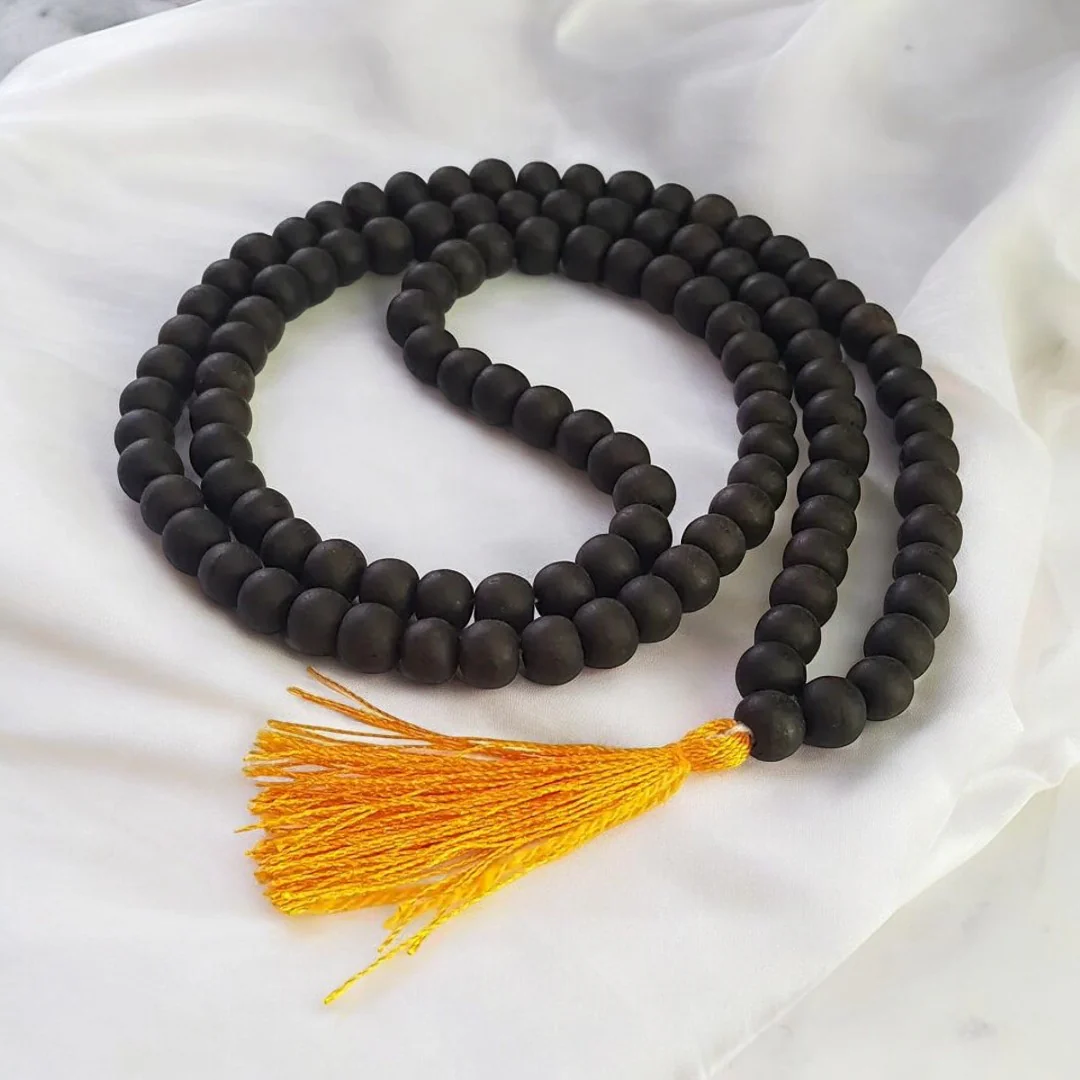
If you’ve ever held a Karungali mala in your hands for the first time, you know that strange, grounding weight it carries. Not just the physical heft of the ebony wood, but something else. Something that feels older than you.
I remember the first time a client of ours described unboxing her Karungali mala. She told me she almost didn’t want to touch it right away. It felt, in her words, “too sacred to rush.” That instinct was right. A Karungali mala isn’t a fashion accessory you throw on and forget. It’s a spiritual tool, one that Tamil sages and Siddhas have relied on for centuries to anchor the mind, ward off negative energy, and create a steady channel for devotion and abundance, including the grace of Goddess Maha Lakshmi.
This guide walks you through everything: how to wear your Karungali mala for the first time, how to maintain it so it keeps its power and shine, and how to chant with it properly so every rotation of the beads works in your favor.
What Exactly Is a Karungali Mala?
Karungali, also known as Indian ebony or Diospyros ebenum, is a dense, dark-grained wood native to South India and Sri Lanka. In Tamil spiritual tradition, it’s considered one of the most powerful protective woods available, largely because of its association with Lord Shani (Saturn) and its documented ability to absorb and neutralize negative energy.
But here’s what a lot of people don’t realize: Karungali isn’t just about protection. It’s also deeply tied to grounding the wearer so that prosperity and abundance, the very energies Maha Lakshmi governs, have a stable vessel to flow into. Think of it this way. Lakshmi’s blessings are like water. Without a strong container, water spills everywhere and goes to waste. Karungali is that container. It steadies your energy field so that wealth, peace, and good fortune don’t just pass through you but actually settle.
Ayurvedic practitioners have also noted that Karungali wood carries a natural coolness, which is why it’s traditionally recommended for people who run “hot” emotionally, those prone to anger, anxiety, or restlessness. A study on traditional Siddha medicine practices published in the Journal of Ayurveda and Integrative Medicine noted that ebony and similar dense woods have long been used in South Indian folk healing for their believed calming and detoxifying properties, though modern clinical research on this specific application remains limited. We share this not as hard science, but as a reflection of how deeply this belief is woven into centuries of lived tradition.
Why the First Time You Wear It Matters So Much
Here’s something most blogs won’t tell you: how you wear your Karungali mala for the first time sets the tone for your entire relationship with it.
Think of it like planting a seed. You don’t just toss a seed onto concrete and hope for the best. You prepare the soil, you choose the right moment, and you plant it with intention. Your mala deserves the same care.
Step 1: Cleanse It Before You Wear It
Even if your mala arrived brand new and untouched, it has traveled. It has passed through hands, packaging, and transit. Before you wear it, cleanse it energetically.
The traditional method is simple:
- Hold the mala under running water for a few seconds, or lightly sprinkle it with Ganga jal (holy water) if you have access to it.
- Pass it gently through the smoke of camphor or sandalwood incense three times.
- Let it dry naturally in sunlight for a few minutes before wearing.
This isn’t superstition for the sake of ritual. It’s about resetting the energetic slate of the beads so that what you infuse into them from this point forward is entirely yours.
Step 2: Choose an Auspicious Time
Traditionally, Fridays are considered ideal for anything connected to Maha Lakshmi, since Friday is her day of worship. Saturdays work well too, given Karungali’s connection to Shani, making it a day of protection and discipline.
Early morning, right after your bath and before you’ve eaten, is considered the most powerful window. Your mind is quiet, your body is clean, and your intentions haven’t yet been diluted by the noise of the day.
Step 3: Set Your Sankalpa (Intention)
Before placing the mala around your neck or wrist, sit for a moment. Close your eyes. Hold the mala in both hands, near your heart, and silently or aloud state your intention.
It doesn’t need to be elaborate. Something like: “I wear this Karungali mala for protection, for grounding, and to invite the abundance and grace of Maha Lakshmi into my life.”
This step is often skipped, and it’s the one people regret skipping the most. A mala worn without intention is just wood. A mala worn with intention becomes a living extension of your will.
Step 4: Wear It
Slip it over your head or onto your wrist. Traditionally, the mala should touch your skin at some point during wear for the energetic connection to be strongest, though wearing it over light clothing is also acceptable for daily comfort.
How to Maintain Your Karungali Mala So It Lasts a Lifetime
A well-maintained Karungali mala can genuinely last generations. We’ve heard from customers whose grandmothers passed down malas that are over 40 years old, the wood darkened and polished from decades of touch, prayer, and time.
Keep It Away From Water and Chemicals
Unlike Rudraksha, which can tolerate occasional water contact, Karungali wood is more porous and prone to cracking if soaked repeatedly. Avoid wearing it in the shower, swimming pool, or while applying oils, perfumes, or lotions.
Oil It Occasionally
Once every few months, a light application of sandalwood oil or coconut oil, rubbed gently into the beads with a soft cloth, keeps the wood from drying out and cracking. Apply sparingly. You want a subtle sheen, not a greasy coating.
Store It With Respect
When you’re not wearing it, don’t just toss your mala into a drawer with your keys and loose change. Traditional practice recommends keeping it in a clean pouch, ideally red or yellow cloth, and placing it near your prayer altar or in a quiet, undisturbed corner of your home.
Don’t Let Others Wear It
This is one of the most commonly asked questions we get. Should you let a friend or family member try on your Karungali mala? Traditional guidance says no. Your mala absorbs your personal energy over time, and letting others wear it, even briefly, can dilute that connection. If someone in your family wants the same benefits, it’s better for them to have their own mala, energized with their own intention.
Mantra Chanting With Your Karungali Mala
This is where the real transformation happens. A mala with 108 beads isn’t an arbitrary number. In Vedic numerology, 108 represents the mathematical relationship between the Earth, Moon, and Sun, and is considered a number of cosmic completeness. Each bead represents one full repetition of your mantra, and the guru bead (the slightly larger bead where the tassel hangs) marks the completion of one full cycle, or “mala.”
Which Mantras Work Best With Karungali
Given Karungali’s dual association with grounding and protection, along with your interest in Maha Lakshmi’s abundance, here are the mantras most commonly recommended:
For Maha Lakshmi’s blessings: “Om Shreem Mahalakshmiyei Namaha”
This is considered one of the most direct invocations of Lakshmi’s energy, combining the beeja (seed) mantra “Shreem,” which represents abundance and beauty, with her full name.
For protection and grounding (Shani-related): “Om Sham Shanicharaya Namaha”
For general spiritual strength: “Om Namah Shivaya”
You don’t need to chant all three. Pick one mantra that resonates with your current life focus and commit to it consistently rather than jumping between multiple mantras.
How to Actually Chant
- Sit comfortably, spine straight, in a quiet space, ideally the same time each day.
- Hold the mala in your right hand, draping it over your middle finger, with your thumb doing the work of moving each bead.
- Never use your index finger to move the beads. In Vedic tradition, the index finger represents ego, and using it is believed to introduce ego into what should be a humble, surrendered practice.
- Begin at the bead next to the guru bead. Chant your mantra once per bead, moving toward yourself with your thumb.
- When you reach the guru bead again after 108 repetitions, do not cross over it. Instead, turn the mala around and begin the next round in the opposite direction.
A full round of 108 repetitions typically takes between 10 and 15 minutes, depending on the mantra’s length and your pace. Many practitioners aim for at least one full mala daily, ideally during Brahma Muhurta, the hour or so before sunrise, considered the most spiritually potent time of day in Vedic tradition.
Addressing the Skeptics
It’s worth acknowledging that not everyone approaches malas from a place of spiritual belief, and that’s okay. Some people wear Karungali purely for its aesthetic and cultural significance, or out of respect for family tradition, without necessarily subscribing to every metaphysical claim attached to it. Others are curious but cautious, wondering if this is simply confirmation bias at work, where the calming effects come from the ritual and meditative breathing itself rather than the wood.
There’s validity in that perspective. Meditation research consistently shows that structured, repetitive practices, regardless of the object used, produce measurable relaxation benefits. What a Karungali mala adds is cultural depth, historical continuity, and, for many, a tangible symbol that makes an abstract spiritual intention feel real and held in the hand. Whether you approach it as sacred technology or as a beautifully crafted meditation aid, the daily discipline it encourages is valuable either way.
Wearing Karungali as a Daily Devotion
A Karungali mala isn’t meant to sit in a drawer, admired occasionally. It’s meant to be lived with. Worn during your morning prayers, held during moments of stress, touched as a quiet reminder of the intention you set when you first put it on.
Whether your goal is protection from negativity, grounding for an anxious mind, or opening yourself to the abundant grace of Maha Lakshmi, the path forward is the same: cleanse it with care, wear it with intention, maintain it with respect, and chant with unwavering consistency.
Over time, you won’t just be wearing a mala. You’ll be wearing a practice, a piece of living tradition that darkens and deepens in meaning with every year you carry it.
Shivaya Namah!


Leave a comment